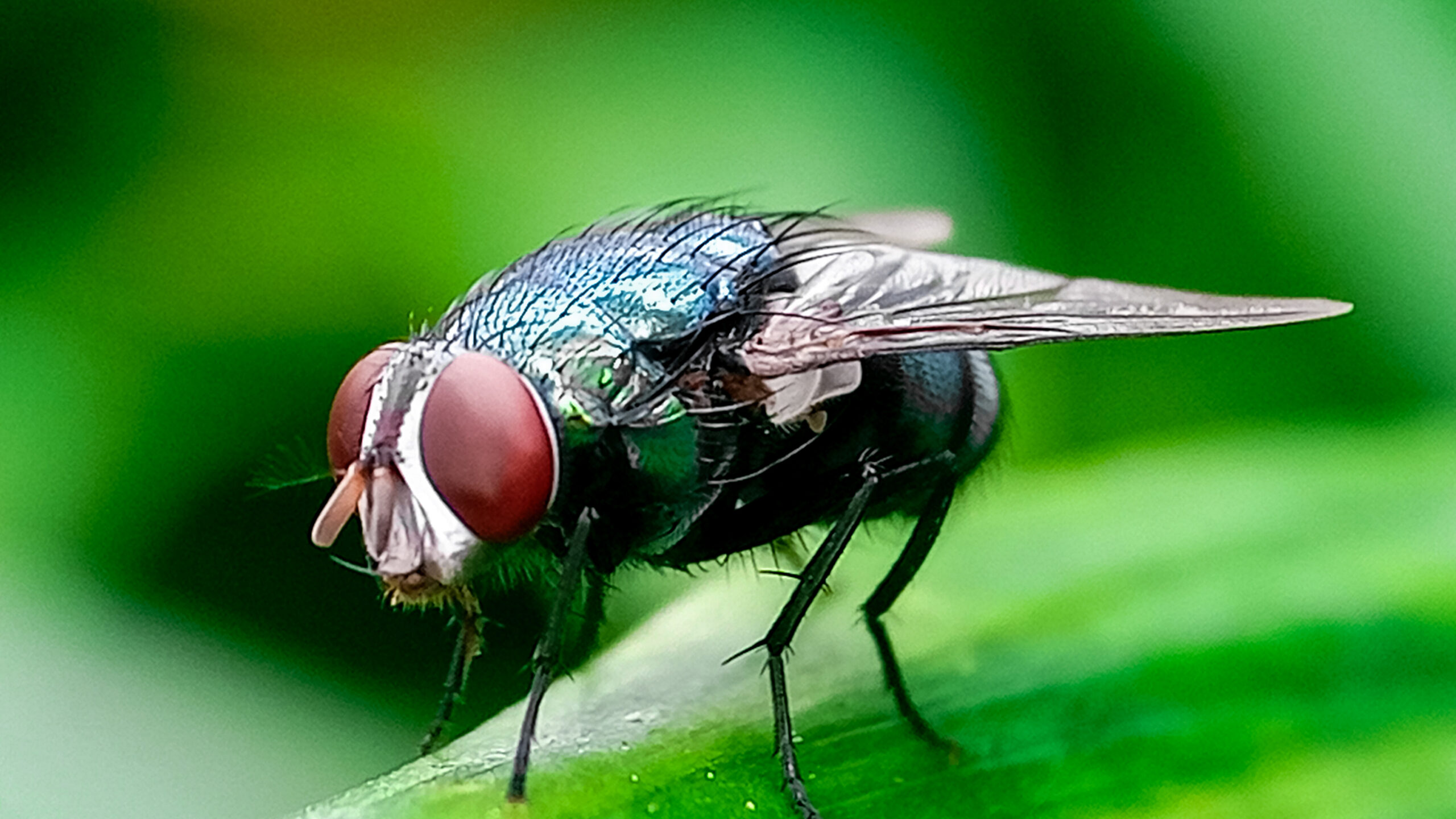
We spent decades eradicating them. But screwworms won’t take the hint, and now they’re back.
The question is, should we be worried?
Without making you read to the bottom of this article, we’ll tell you right now: yes.
But not because it’s going to dry up the nation’s milk supply. By every account we’ve heard, it won’t. Even so, it’s not a matter of whether New World Screwworm will hit U.S. dairy but when.
On June 29, the Jacoby team sat down to discuss the spread of New World Screwworm with Jamie Jonker, chief science officer and vice president of sustainability and scientific affairs for the National Milk Producers Federation, and Sarina Sharp, risk manager at Ag Business Solutions. You can check out the whole conversation on The Milk Checkpodcast. In this article, we cover:
Where they are
What New World Screwworms do
What to look for
What to do if it shows up
Is milk from New World Screwworm-infested cows safe?
Why New World Screwworm is unlikely to have a huge dairy production impact
How rising cull checks help dairy farmers
How long will this New World Screwworm invasion last?
If you’re worried about how New World Screwworm might impact your dairy ingredient supply chain, read on. Or contact us and let’s see how we can help.
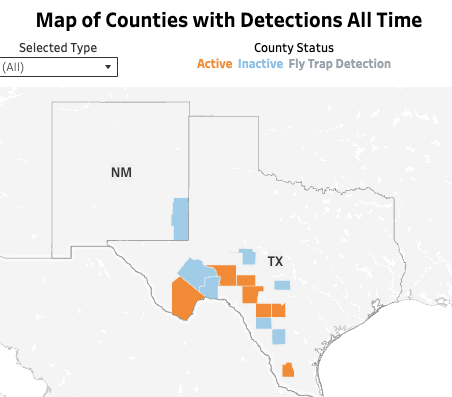
According to the USDA map of New World Screwworm Confirmed Detections as of Tuesday, July 14, 2026, there have been 37 animal detections of New World Screwworm in the U.S. since the first case in Zavala County, Texas, on June 3 of this year.
Source: USDA map of New World Screwworm Confirmed Detections, located here.
As of publishing date, there are 17 active cases, and all of them are in Texas. The Texas Animal Health Commission maintains a map of current zones, and as detections rise, some of those zones have begun merging into a single large area near the border. For up-to-date data, check out the USDA page on Confirmed Detections of New World Screwworm here.
So far, the confirmed cases of screwworm have been in cattle, dogs, goats, and sheep. Of the cattle, all have been beef cattle; most are castrated males. There hasn’t been a case of New World Screwworm in a U.S. dairy. Yet.
But dairy farmers need to get up to speed now, because those little files are on the move.
What New World Screwworms do
The New World Screwworm fly lays its eggs in any open wound on a warm-blooded animal. It doesn’t have to be a huge wound. It can be as small as a tick bite.
The female fly lays 200 to 300 eggs at a time, and the larvae eat living tissue, not dead tissue. A New World Screwworm infestation can move quickly and cause a lot of harm to the animal if it isn’t caught quickly.
One danger point for U.S. dairy is in newborn calves. Screwworm can attack newborn calves through the open umbilical cord wound. Left untreated, mortality in infected calves can approach 50%. Caught early, it’s highly treatable.
But it isn’t contagious in the way avian flu is. It doesn’t pass directly from animal to animal. The larvae have to mature into flies, mate, and lay eggs in a new host before they spread further.
However, an infestation can be brutal for an individual animal and disruptive at the individual-farm level if it shows up. Farmers need to know what to look for to catch and stop infestations early to protect animal health.
What to look for
According to the USDA, signs of a New World Screwworm infestation include:
“Larvae (maggots) and eggs in or around body openings such as the nose, ears, and genital areas, or the navel of newborn animals
Draining or enlarging wounds
Foul odor or the smell of decay
Signs of pain such as irritated behavior, depression, not eating or isolating from other animals or people”
See the NMPF New World Screwworm Resources page for more info.
So, once a case shows up in your area, what then?
What happens next depends on how far you are from a USDA-confirmed case of New World Screwworm.
Location, location, location
When a case is reported, the USDA implements mitigation and prevention measures. The measures in place depend on the distance from the initial animal or fly detection. Here’s what that looks like:
20 km Infested Zone. The USDA draws a minimum 20 km (12.43 mile) circle around the location of the detection. Animals within the circle are quarantined. Moving animals out of the quarantine zone requires a permit, an inspection, and, in some cases, preventive treatment. See more about requirements for moving animals here. Animal and fly surveillance for New World Screwworm takes place within the Infested Zone. See more about the USDA New World Screwworm Response Playbook here.
20 km Adjacent Surveillance Zone. The USDA draws a second 20 km circle around the Infested Zone. Animal and Fly surveillance takes place within the Adjacent Surveillance Zone. See the USDA’s Ready Reference Guide for a quick primer on the zones around a New World Screwworm detection here.
0 to 200 km Fly Surveillance Area. The USDA draws a circle somewhere between 0 and 200 km (about 124.27 miles) around the infested animal or fly detection. Fly surveillance takes place in this area.
Now, on to what to do if you’ve got New World Screwworm in your herd.
Treatment options
Call your vet. New information is coming out all the time, including:
The August 2025 HHS declaration, announced via an FDA news release, stated that the Health and Human Services (HHS) would allow the FDA to use Emergency Use Authorizations (EUAs) for animal drugs to combat New World Screwworm. This is the first time the HHS Secretary has issued an EUA declaration for animal drugs.
The subsequent May 2026 FDA EUA allowing the use of Dectomax/Dectomax-CA1 (doramectin injection) injectable solution to prevent New World Screwworm in lactating cows.
So, call your vet.
There are also several topical treatments authorized for animals with an active infestation. The FDA has a page designed for veterinarians about the types of drugs approved to treat or prevent New World Screwworm.
If an animal in a herd is infested, after you report it and call your vet, isolate the animal, clean and treat the wound, and watch the rest of the herd for new fly activity. Discard milk while the animal is being treated and during withdrawal periods as directed by the treatment. Unless a broader prevention protocol is warranted, milk from the untreated herd mates can continue to flow normally, so long as it meets the usual residue standards.
But does an infestation in one cow mean the rest of your cows are doomed to get it?
Prevention options
The National Milk Producers Federation (NMPF) suggests four methods for preventing New World Screwworm in your herd if there is an outbreak in your area:
Delay procedures like dehorning, castration, etc., to prevent wounds.
Keep your facilities free of sharp objects where cattle might injure themselves.
Prevent pests that cause wounds, like ticks. Even a tick bite is small enough for a New World Screwworm to enter.
Treat all wounds with approved insecticides.
Read more about the NMPF’s advice on preventing New World Screwworm here.
Dairy farmers can also use Dectomax/Dectomax-CA1 to prevent screwworm in lactating dairy cattle. It’s an injectable with a 468-hour (19.5-day) milk withdrawal and a 35-day meat withdrawal for dairy cows, dry cows and replacement heifers. That means that you have to wait 35 days after the last dose before slaughtering animals for human consumption, and 19.5 days after the last dose before milk can be used for consumption.
Is milk from New World Screwworm-infested cows safe?
Post-treatment and withdrawal period, yes, it’s fine.
“An infestation is an animal health and welfare issue,” Jamie Jonker said in the podcast episode. “It’s not a food safety issue for meat or milk.”
The International Dairy Foods Association (IDFA) backs this up: New World screwworm isn’t a foodborne pathogen and doesn’t spread through milk, making it an animal-health and farm-operations issue rather than a dairy product safety issue. Read the IDFA’s June 18, 2026, article, “New World Screwworm and U.S. Dairy: What to Know” here.
According to the IDFA article, “When animal health treatments are used, established veterinary protocols, including milk discard times and withdrawal periods, help ensure milk entering the food supply meets federal safety standards. New World Screwworm does not affect the safety or the quality of milk and other dairy products.”
June 18, 2026, IDFA article, “New World Screwworm and U.S. Dairy: What to Know,” located here.
So, milk can’t be used while animals are being treated for New World Screwworm, while they are on preventative treatment, or during the withdrawal period. But other than that, there is no known impact on food safety.
Why New World Screwworm is unlikely to have a huge dairy production impact
Dairy operations have a built-in advantage over beef ranches when it comes to catching New World Screwworm early, according to Sarina Sharp. While beef cattle on range country might go days between checks, that doesn’t happen with dairy cows.
Dairy farmers milk cows, bottle-feed calves, and check heifers multiple times a day. That difference in hands-on contact matters for spotting a wound before it becomes an infestation.
Plus, while they’re being treated, milk from lactating cows must be discarded; once the mandatory withdrawal period has passed, cows can resume production.
The U.S. normally imports more than a million Mexican feeder cattle a year to feed and finish domestically. With the border closed, that supply is gone, and it’s not coming back on any near-term timeline.
All this disruption means that New World Screwworm’s biggest economic bite right now is in beef, not dairy, and it’s already showing up in cull cow and calf checks.
Beef-on-dairy calves and cull dairy cows are commanding record prices.
“I was talking to a producer last week who sold one full truckload of dairy cull cows at an average price of $3,500 per animal,” says Sharp.
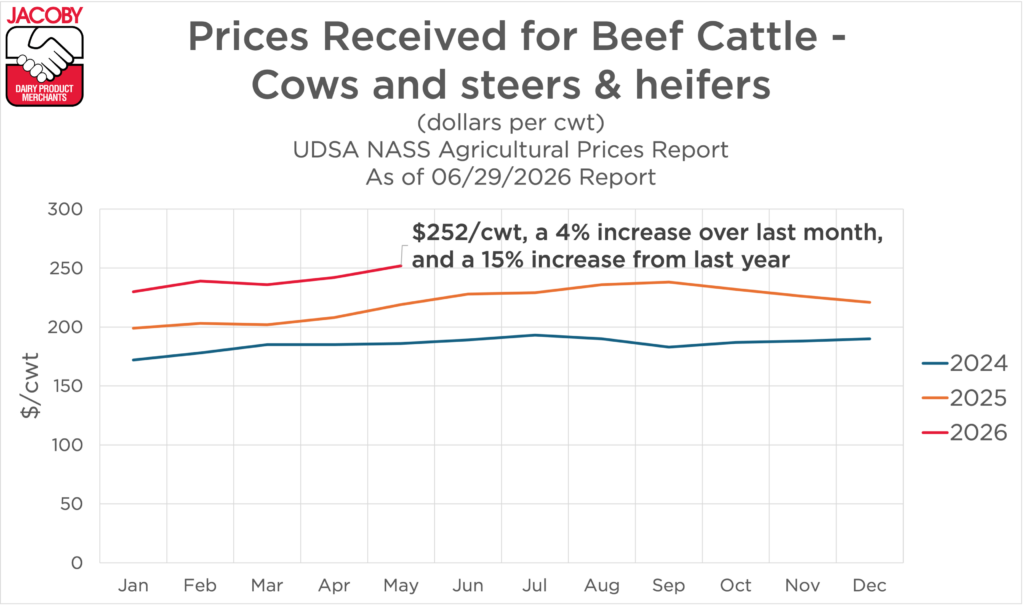
Beef prices have been rising for a few years now, and according to the latest USDA NASS Agricultural Prices report, May 2026 beef prices per cwt were up 15% from last year. With low milk prices and high feed costs, the higher prices dairy farmers receive for culled cows are a welcome boost to their bottom line.
The longer the border closure lasts, the more Mexico invests in its own finishing and packing capacity, which means the U.S. increasingly imports finished Mexican beef instead of live feeder cattle. That’s good for dairy producers supplying young stock now, and a longer-run headache for the U.S. beef-finishing industry.
How long will this New World Screwworm invasion last?
Stopping screwworm means flooding affected areas with sterile flies so wild females mate with sterile males and lay eggs that never hatch.
The U.S. has several sterile fly production and dispersal facilities. Right now, the U.S. is leaning on a facility in Panama and a renovated fruit fly plant in Mexico, expected to reach full production by the end of 2026. A new domestic facility on a military base in Edinburg, Texas, is targeting 300 million flies a week, originally slated for late 2027, with USDA reportedly working to move that timeline up.
In summary, this may take a while.
Who should worry, and who should watch
The national story, for now, is a beef-market story: tighter feeder cattle supply, a closed border and record calf and cull cow prices flowing back to dairy producers.
Farmers should worry about animal health on the dairy and take steps to prevent and treat New World Screwworm.
Beef buyers should worry (as we have been worried for several years now) about rising beef prices.
Dairy should keep a wary eye out. Dairy ingredient buyers likely don’t need to worry about major disruptions to milk production from New World Screwworm. You can worry instead about how America’s protein obsession is rewriting the whey market.
To learn more, check out the full conversation, where we cover:
New World Screwworm
H5N1 avian flu
Foot-and-mouth-disease
Listen to The Milk Check episode 101: Screwworm, Bird Flu, and Foot-and-Mouth Disease: Is U.S. Dairy Ready? Available on the Jacoby website here. Also available on Amazon Music, Apple Podcasts, Spotify, or YouTube.
Keep an eye on the market with Jacoby
We’re following screwworm’s spread and its ripple effects on cattle and dairy markets as they develop. Get the latest with our weekly Market Reports or our twice-monthly podcast, The Milk Check.
Listen to The Milk Check — the most comprehensive podcast in the dairy industry.